Choosing a CRM often comes down to a single question that vendors rarely answer honestly: what job are you actually hiring the software to do?
Pipedrive and GoHighLevel are two of the most discussed platforms in this space, but they are built for fundamentally different buyers. Pipedrive is a focused sales-pipeline CRM. GoHighLevel is an all-in-one marketing and client-management platform. Understanding that distinction is the key to picking the right one for a professional sales team.
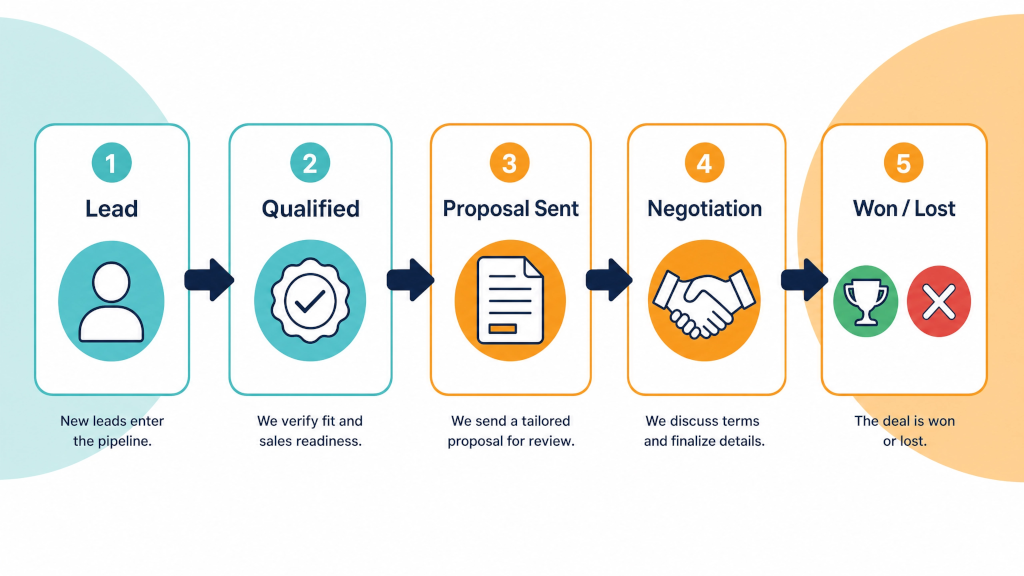
Pipedrive is a sales-first CRM designed, in the company's own framing, by salespeople for salespeople. It's centred around on a visual, drag-and-drop pipeline that makes moving deals through stages fast and intuitive - fast enough that your sales reps actually keep the pipeline updated, which matters more for adoption than it sounds. Its strengths are deal tracking, activity-based selling, forecasting, and sales reporting.
In our experience the usability of a CRM is what enables user adoption. If your CRM is clunky and poorly designed your sales team are less likely to use it and will spend too much time buried in spreadsheets and manual systems.
GoHighLevel takes the opposite approach to Pipedrive. It bundles a CRM together with email marketing, SMS, funnels, websites, booking, chat, AI tools, and reputation management under one subscription. Its defining feature is multi-tenant architecture: sub-accounts and white-labeling that let an agency run separate, isolated environments for each client. It is built less for an individual sales team and more for agencies deploying tools across many clients at once.
That architectural difference drives nearly every trade-off between them - pricing, feature depth, and who ends up happy with their choice.
Pipedrive prices per seat. Following its 2025 plan rename, the current structure runs roughly from a Lite tier around $14/user/month up through Premium and Ultimate tiers in the $59–$79/user/month range (annual billing). Add-ons such as LeadBooster, Smart Docs, and Campaigns stack on top, so the real monthly cost often exceeds the headline per-seat number. More information on pricing is available on the Pipedrive Pricing page.
GoHighLevel uses flat-rate pricing, starting around $97/month for its entry plan with unlimited users and contacts, and $297/month for the Agency Unlimited plan that unlocks client sub-accounts. Usage-based fees apply for SMS, email, and phone volume. More information on the GoHighLevel Pricing page.
The two pricing models simply suit different team profiles. Pipedrive's per-seat approach is cost-effective for smaller teams and scales with headcount, so you pay for the sales capability you actually use.
GoHighLevel's flat rate, by contrast, bundles a broad marketing toolset into a single price, which can make it economical for larger teams or those that also need funnels, SMS, and websites under one subscription.
Which works out cheaper depends less on the headline numbers and more on team size and how much of each platform's toolset you'll genuinely use - a focused sales team and a full-stack marketing operation will reach different conclusions from the same price lists.
* More on Pipedrive calling integration.
For a professional sales team specifically, Pipedrive's key advantage is depth where it counts. Its pipeline is more refined for daily deal management, its forecasting projects monthly and quarterly revenue from weighted pipeline, and its AI Sales Assistant points out win-probability signals and next-best actions. In early 2025 Pipedrive also added AI-powered report creation built on OpenAI's technology, allowing sales reps to generate reports from natural-language prompts. While I personally prefer to hand craft reports in Pipedrive still, this feature is very useful for those less experienced at generating reports in Pipedrive and allows for a shorter learning curve.
Pipedrive CRM is not without gaps, though fewer than critics suggest. Pipedrive does offer a built-in phone dialer and an excellent mobile app for calling, so reps aren't forced onto third-party tools to reach prospects. Its integration story is a genuine strength: one of the market's best APIs (The new v2 API is a big improvement on V1 in my opinion), plus deep support for Make.com and Zapier, means the ceiling on automation and connectivity is effectively limitless. On the marketing side, Pipedrive Campaigns handles email outreach natively, and the platform integrates cleanly with a wide range of marketing-automation tools.
We often pair Pipedrive with MailerLite, for example - one of the most productive environments around for building newsletters, powerful email automations, forms, and landing pages. The real limitations are narrower: reporting on lower tiers is fairly basic, and forecasting leans on stage probability rather than true AI-driven prediction. Teams that want all of this consolidated under a single subscription rather than assembled from best-in-class parts may prefer an all-in-one platform - but for teams that value depth in each tool, Pipedrive's flexibility is an advantage rather than a gap.
The clearest signal of the two platforms' different design philosophies shows up in how users rate them - especially on ease of use.
Pipedrive is consistently recognized for usability. It ranked #6 on G2's Best Sales Software Products 2026 list, a ranking built entirely on verified user reviews - well ahead of GoHighLevel, which placed #31 on the same list. Pipedrive was also recognized in G2's Top Overall Software (#53) and Top Product Customer Satisfaction (#37). On G2 it holds an ease-of-use score of 8.9/10 - ahead of Salesforce (8.2) and HubSpot (8.7) - and an overall rating of roughly 4.3/5 from 2,700+ reviews. On Capterra, 93% of nearly 600 reviewers who rated ease of use praised its simple interface and quick setup. The recurring themes across G2, Capterra, and TrustRadius are the intuitive drag-and-drop pipeline, fast time-to-productivity, and a clean UI that reps actually adopt - exactly what you'd want from a sales-first tool.
GoHighLevel earns strong ratings too, but on a different basis. Across 5,200+ reviews it scores around 4.2/5 on G2, 4.6/5 on Capterra, and 4.6/5 on Trustpilot - with its 4.6 Capterra score among the highest in the marketing-automation category. Users praise the value of tool consolidation (often saving $200–$500+ per month versus a separate stack), the AI features, and the white-label SaaS mode for agencies. The consistent caveat, though, is usability: the single most-cited criticism across review platforms is a steep learning curve, with onboarding typically taking 2–4 weeks rather than days. Reviewers describe the interface as feature-dense and at times cluttered, with settings scattered across menus. Ease-of-use sub-scores reflect this - some review sites put it as low as 3/5 for ease of use even while rating features 4.7/5.
The takeaway for UX: Pipedrive wins on out-of-the-box simplicity and rep adoption, while GoHighLevel rewards the time invested to master a much broader platform. For a sales team that needs people productive on day one, that difference matters.
For a dedicated B2B sales team whose job is to move deals through a pipeline, Pipedrive is the stronger fit. It does one thing exceptionally well, sets up in hours rather than weeks, and gives sales reps a clean, visual workspace they'll actually use. In our experience, active Pipedrive users tend to absolutely love the platform - we often having clients mention how their business has been transformed and how they love the platform for it's usability and the clarity it brings to their business. The forecasting, activity tracking, and large integration library round out a tool genuinely built around the sales process rather than around marketing operations.
GoHighLevel makes more sense when the "sales" job is really a broader go-to-market job - when the same team also runs the funnels, email and SMS campaigns, booking, and websites, or when an agency needs to manage all of that across multiple clients under one white-labeled roof. In that scenario its all-in-one bundle replaces a stack of separate tools and the per-seat math works in its favor at scale.
A useful test: list every tool your team currently pays for. If the answer is essentially "a pipeline and some integrations," Pipedrive is the cleaner, more capable choice for professional selling. If the list also includes a funnel builder, an email platform, an SMS tool, a scheduler, and a website host - especially across several clients - GoHighLevel's consolidation becomes compelling.
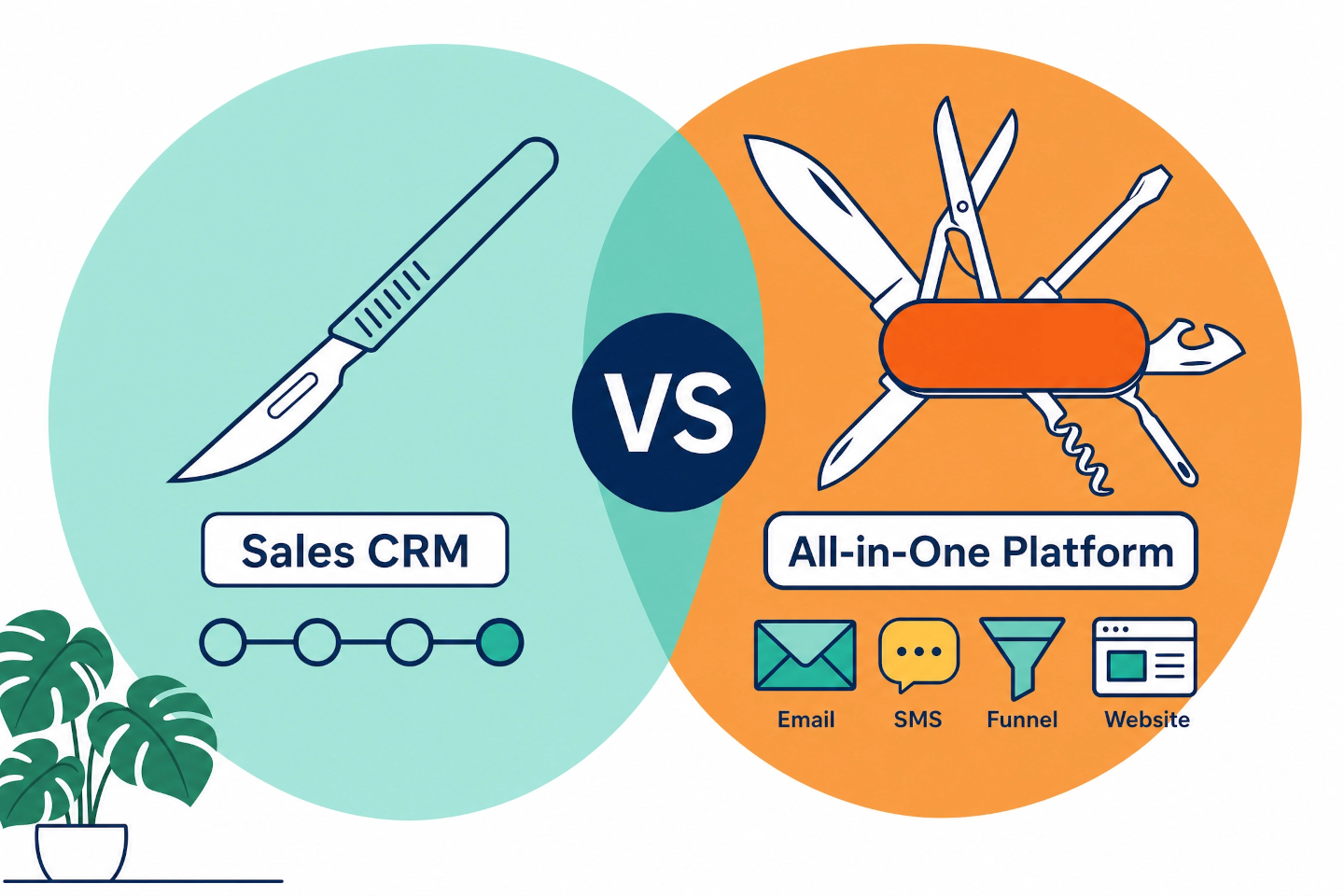
Comparing these two is less about which is better and more about which problem you're solving. Pipedrive is a scalpel for sales; GoHighLevel is a Swiss Army knife for agencies and service businesses. For professional sales as a discipline - pipeline discipline, deal forecasting, rep adoption, sales reporting - Pipedrive remains the more purpose-built option, with the caveat that teams needing native calling or heavy marketing automation will need to look beyond it.
Choosing the right platform is only half the battle - setting it up to actually drive sales is where the real value lives. At Process Culture, we help teams implement, integrate, and optimize Pipedrive and the surrounding stack so your CRM works as hard as your sales team does.
Book a call with Process Culture →
Pricing and plan details verified against public sources as of early-to-mid 2026. Vendors adjust plans and pricing frequently, so confirm current rates at pipedrive.com and gohighlevel.com before making a decision.