As someone who writes extensively about CRM and happily 'geeks out' on all things sales and process, I've seen a consistent pattern emerge. While I'm a strong advocate for Pipedrive in particular, this pattern holds true whether you're using spreadsheets, paper-based systems, legacy technology, or a different CRM platform entirely.
The pattern? Businesses are solving the wrong problem.
Underlying all our advice at Process Culture is an approach broadly applicable to all businesses: a focus on process first.
In fact, if you're working with a consultancy who dives straight into CRM before understanding your sales process, you're likely to be off-track with your implementation right from the start.
This isn't just theory. It's what we see every single day in practice.
Most businesses don't come to us because they love their CRM or even because they woke up thinking "I need a CRM."
They come to us because something feels heavier and more challenging than it should.
They've noticed that follow-ups are being forgotten (and we live by the saying "the fortune is in the follow-up").
Data is inconsistent.
Automation may or may not exist, but there's often a lack of trust in what they're using.
Perhaps the system technically works, but people are still relying on their own memory, email inboxes, and spreadsheets to get things done.
Being aware of challenges in your sales process, it's tempting to think the answer is a better tool, fancier automation, or a more advanced setup combining AI and automation.
In our experience, that rarely gets to the bare bones of the issue.
Most CRM problems are not software problems. They're process problems.
Software has a habit of amplifying whatever process already exists—whether that process is good or bad.
If you have a fantastic process in place, CRM and automation can help what already works shine. But without a clear process, CRM is no silver bullet. I've seen enough messy CRM pipelines—that don't reflect the actual sales process—to know this is the case.
Think about it this way: if you automate a broken process, you just get a faster broken process. The technology magnifies what's already there. Good or bad.
When we talk about "process", we're not talking about red tape, flowcharts on a wall, or endless documentation that no one reads.
We're talking about clarity.
Clarity around:
This is why we always start with process. Always.
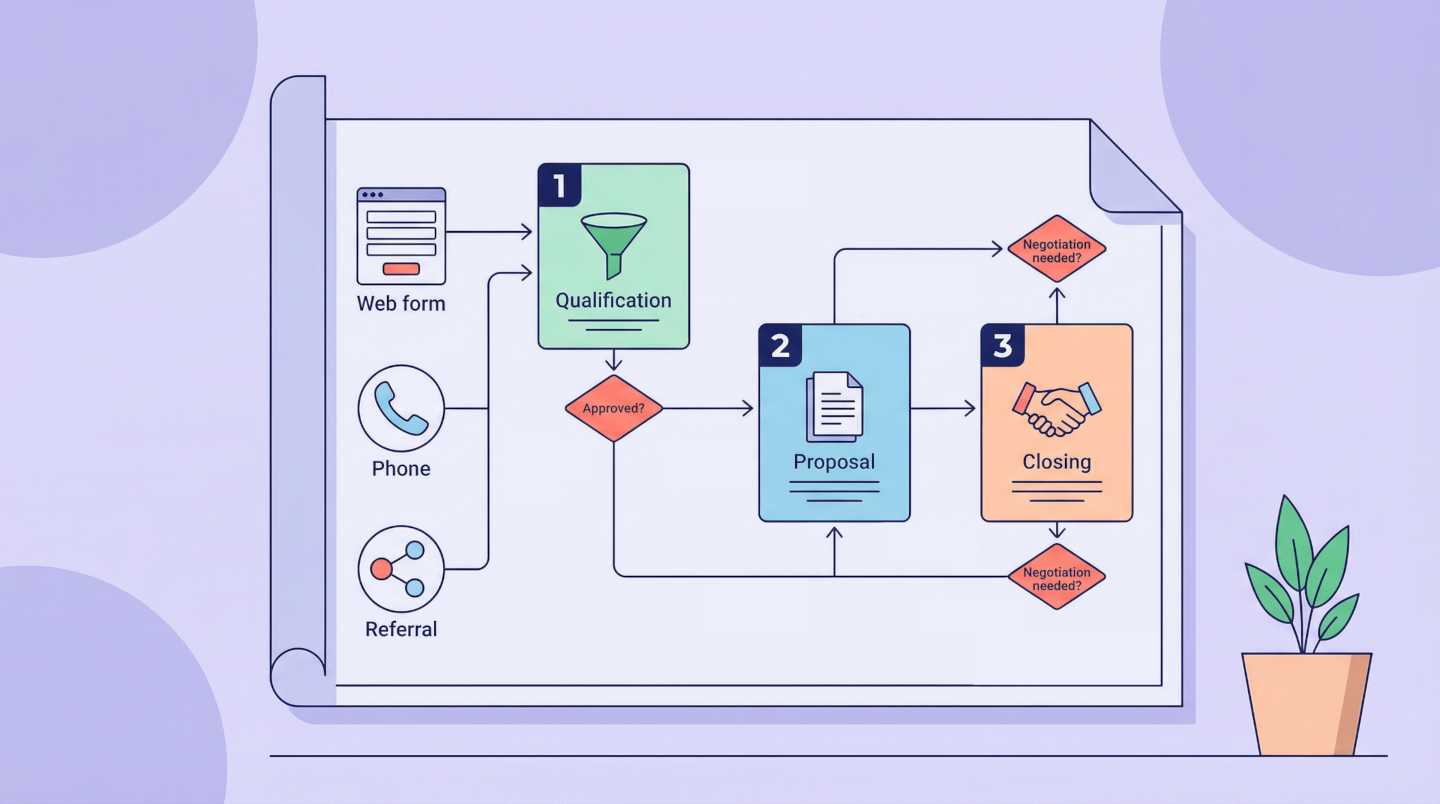
Mapping out your sales process visually allows your team to have a shared understanding of how you actually sell. Not how you think you sell. Not how the theory says you should sell. But how sales actually happen in your business, day to day.
Visual mapping then provides a blueprint that you can use to develop your CRM and supporting technology.
This blueprint becomes the foundation for everything else:
I believe that a process-first approach is the most reliable way to design CRM systems that are simple, scalable, and genuinely useful—regardless of the tool you're using.
Here's why this matters:
When you start with process, you're building from reality, not from what the software vendor thinks you should do. Your CRM becomes a tool that serves your business, not a system your business has to contort itself to serve.
When your CRM reflects how people actually work, adoption becomes natural. There's no forcing square pegs into round holes. The system makes sense because it maps to what people are already doing—just organized, consistent, and visible.
Getting the process right first means you implement once, properly. Not implement, realize it doesn't work, tear it down, and start over. Every business I've worked with that skipped the process step ended up either abandoning their CRM or doing a complete rebuild within 18 months.
A clear process documented in your CRM means you can onboard new team members effectively. They can see exactly how leads move through the system, what's expected at each stage, and where they fit in. Your business isn't dependent on the knowledge locked in one person's head.
You can't improve what you can't see. When your process is mapped and visible in your CRM, you can identify bottlenecks, measure conversion rates at each stage, and make data-driven decisions about where to focus improvement efforts.
Over the years, I've seen the same process problems show up again and again:
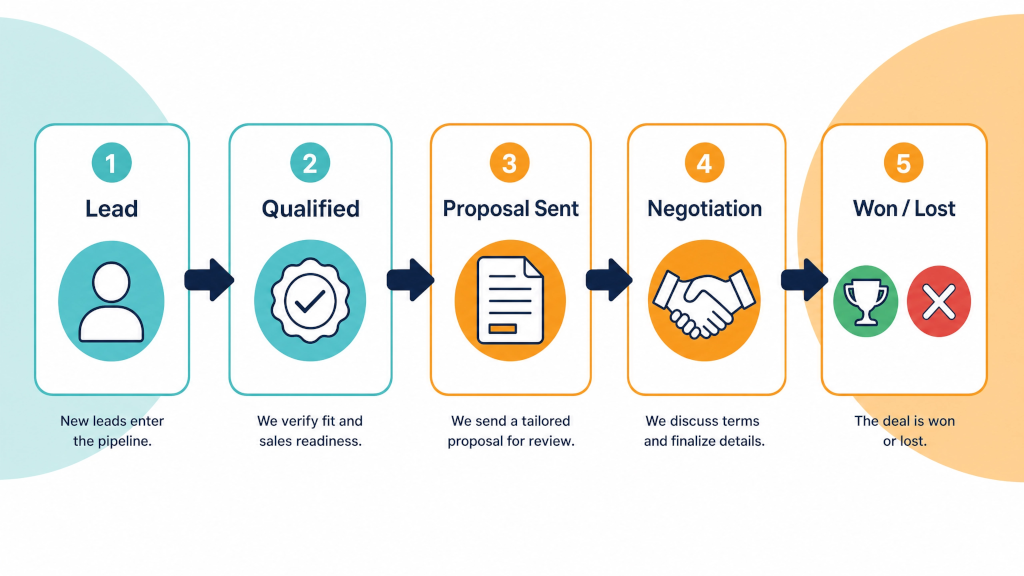
Pipeline stages like "Qualified", "Proposal", "Negotiation" sound professional, but do they match what actually happens in your sales cycle? Often they're generic templates that don't reflect the real decision points in your business.
What happens when a lead comes in? Who takes it? When? What's the SLA? If this isn't crystal clear in your process (and therefore in your CRM), leads fall through the cracks. Every. Single. Time.
When does a lead move from one stage to the next? If your team doesn't know this clearly, you get inconsistent data. One salesperson's "qualified" is another's "contacted". Your pipeline becomes meaningless.
The fortune is in the follow-up, but if your process doesn't define when and how follow-ups should happen, they won't. And no amount of CRM features will fix that.
Too many CRMs are designed to generate reports for management, not to help salespeople sell. When your process is designed around what matters for closing deals, your data requirements become clear and relevant.
If you're reading this and thinking "okay, I get it, but where do I start?", here's the practical approach:
Not what should happen. Not what the textbook says. What actually happens when a lead comes in today. Walk through it step by step with your team.
Where do leads get stuck? Where do you make decisions about whether to continue? These become your pipeline stages.
What has to be true for a lead to move from one stage to the next? Write it down. Make it specific.
What actions need to happen at each stage? Who does them? When? This becomes your playbook.
Now you know what you need your CRM to do. Now you can evaluate tools based on how well they support your actual process, not based on feature lists.
Your CRM should be a reflection of a well-thought-out sales process, not a replacement for one.
Get the process right first. Document it. Test it. Refine it. Then implement technology that supports what works.
This approach takes longer upfront. It requires more thinking and less clicking. But it results in systems that actually get used, sales processes that actually work, and teams that actually have clarity about what they're supposed to be doing.
And that's worth far more than any feature list.
If you want help implementing a process-first approach in your business, we offer a complementary 30-minute sales process review where we'll discuss your current sales process and identify potential gaps that are currently costing you business.
Get in touch to book your free review
If you'd like to carry out a quick self-assessment of your sales process, here's our Sales Process Mastery Scorecard - 15 questions and loads of insights.